Showing posts with label *PP#5. Show all posts

Wednesday, April 20, 2016

Hawking on Space Travel

https://nationalpostcom.files.wordpress.com/2016/04/520642806.jpg?quality=65&strip=all&w=620


               The economics of outer space can be a blurry area. As we have seen there are many factors that must be taken into account when determining if space travel is economically a good idea. In my last article we explored the alternatives to space travel and what we could be using that funding on here on Earth. It all certainly caused questions to arise about the topic. However, Stephen Hawking, a world famous physicist and cosmetologist, has put doubts to rest in a lecture he gave to a group at George Washington University. He brings up the points that we are in a golden age for exploration and funding for space travel, as well as how we can do all of this while increasing funding and research in other problems on Earth. 

               Hawking starts his lecture by disproving a common misconception that space travel is extremely expensive. He notes that though from a numbers point of view it may seem like they are spending drastic amounts of money, but when you compare how much NASA spends compared to the national GDP it comes out to roughly 0.1%. Hawking also notes that the world has access to more resources that ever at this moment in time and it is important to allocate some of those resources to NASA now so that down the road we will not be forced to blow off space travel when faced with a scarcity of resources. Hawking believes that if we could increase spending on NASA by doubling it then we could be exploring possible host planets in two-hundred years, and he says all of this is possible while protecting our homeland. 

             Hawking brings up a curious point where he explains that it doesn't matter how much we spend on things as long as they are worth their cost. From his point of view, defense is a commonly over budgeted program by governments and that money should be going towards space exploration as well as a number of other things, specifically the environment. I would agree with this statement in that we do not have much need for large defensive budgeting at this point in time. Most of our warfare is technological and the cost far exceeds what it should at this point in time. Hawking brought up data suggesting that the U.S. cutting back on defensive spending could double spending in environment conservation as well as NASA, all while still spending more on defense than any other country in the world. This all helps explain a solution to everyones interests concerning this debate and I believe that all sides benefit from Hawking's argument. It is uncertain if cutting back on defense and increasing in NASA is practical, but it is an idea that may spark hundreds more.

So let's talk $$$ here...

http://specials-images.forbesimg.com/imageserve/492638336/960x0.jpg?fit=scale
Isn't vinyl dead? Isn't it a thing of the past? 

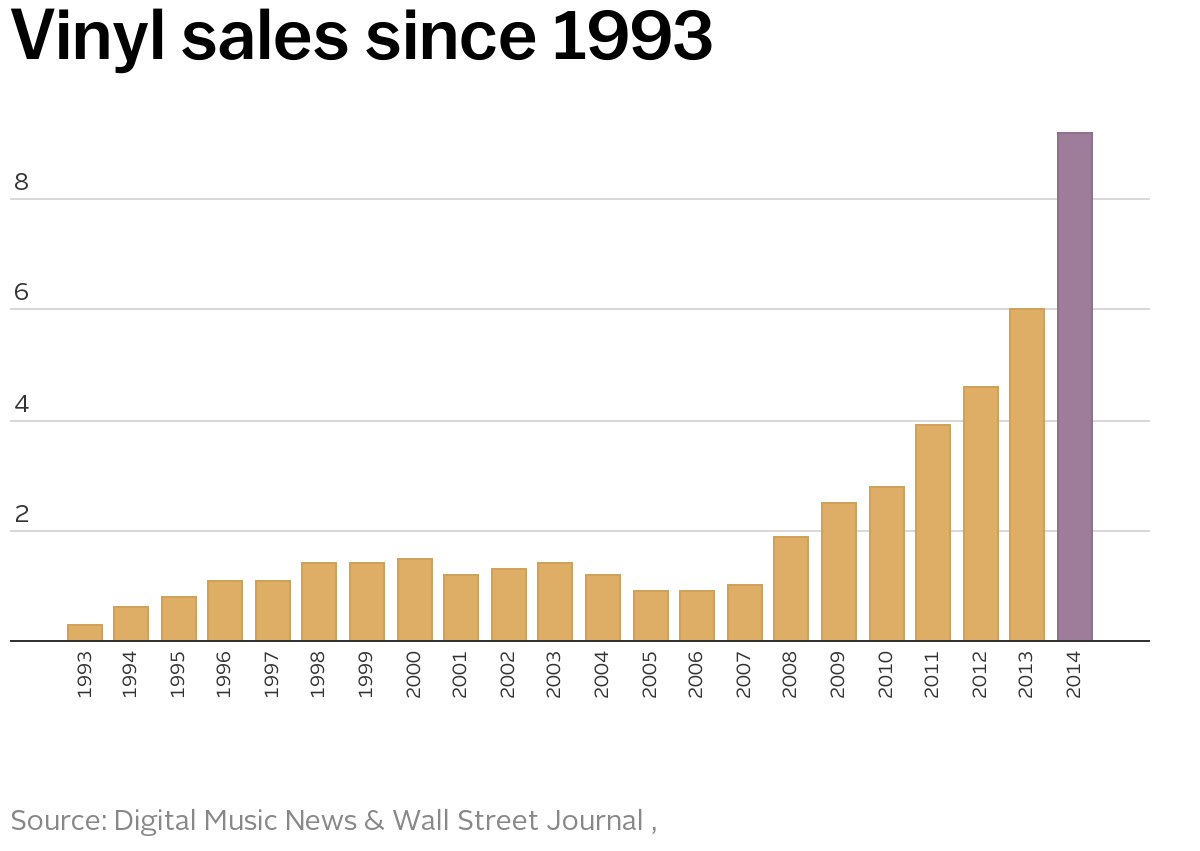
Well.. Yes... but that doesn't seem to stop sales. Last year record sales jumped up by almost 3 million more records sold than the previous year. Sales are now 13 times what they were in 2006. To be clear, 11.9 records were sold in 2015. Big chains are begin to sell records as well, not just local shops. (though I would argue those are still the best and least expensive) Urban Outfitters has begun to sell vinyl, Barnes and Noble, and even Best Buy. 

The records that are being sold are not just old records, but newly released albums are being transferred to vinyl format. The number one best selling album of 2015 was Adele's 25, following that was Taylor Swift's 1989. Others on the top ten are Arctic Monkeys, Alabama Shakes, and Hozier. So as you can tell, the albums being sold are from new artists.


why is deforestation such a problem?

source: https://www.pexels.com


The majority of the world is very aware that deforestation is a problem. However, most of the time it is brushed aside in order to deal with all the other issues that our world is dealing with. In my opinion, if we could solve our deforestation problem, we could also solve some of the other pressing issues that are currently happening in the world. One question I keep thinking to myself is, why is deforestation so bad? Can't we just plant more trees? But in my research, I found that it is so much more than just planting some more trees. 

According to Live Science, "about half the forests have already been cleared" so far. That's 30% of the worlds land mass! (national geographic) We are destroying the only planet we have to live on! Soon all the trees we cut down to make paper and other goods wont matter in the slightest because we will literally all be dead. Another shocking statistic I found was this: "since the last century, Indonesia has lost at least 15.79 million hectares of forest land, according to a study by the University of Maryland." So many people, animals, and plants have lost their lives so we could have some paper. 

In my opinion, cutting down the only supply of trees we have should not be happening. Deforestation should be stopped immediately. This modern era we live in could easily be sustained by going paperless. Not to mention the amount of money, lives, and opportunity cost we would save. 

Caity Tirakian Blog Post #5 "Free Range Helicopter"

PP #5
Caity Tirakian Period-1 
Title: Free Range Helicopter


According to the Developmental Psychology Department at Vanderbilt, there are four main styles of parenting: Neglectful, Authoritative, Permissive, and Authoritarian. Obviously there is no one clear formula that will work on every child but the most effective in raising normal children is the one that falls between the extremes which is Authoritative. 
Neglectful is one of the most ineffective and harmful parenting tactics. Neglectful parents fail to care for the child’s emotional and physical needs, they don’t seem to have an understanding of what’s going on in the child’s life (who/what their friends, teachers, or hobbies are), or leaving the child alone frequently. “Neglectful parenting is damaging to children, because they have no trust foundation with their parents from which to explore the world.” Additionally, children who have a negative or absent relationship with their parents may struggle to create meaningful relationships. 
Authoritative parenting is widely regarded as the most beneficial parenting style for both the parent and child. Authoritative parents “are easy to recognize, as they are marked by the high expectations that they have of their children, but temper these expectations with understanding a support for their children as well. This type of parenting creates the healthiest environment for a growing child, and helps to foster a productive relationship between parent and child.” Authoritative parents create structure for their children with reasonable schedules and expectations. They have a healthy communication system with their children where they try to understand the child’s perspective but still expect the child’s respect. This parenting style is a happy medium between strict and too easy going. 
Permissive parenting can also be known as indulgent parenting. “These parents are responsive but not demanding. These parents tend to be lenient while trying to avoid confrontation.” While these parents tend to be very nurturing and loving, few rules are set for their kids. This inconsistency and lack of discipline can lead to the child’s misunderstanding of societal norms and expectations. It was found that, “that teens with permissive parents are three times more likely to engage in heavy underage alcohol consumption.”  These children often find difficulty following the rules in a school or work environment because they aren’t used to them in family life. “It may seem as though this would be a child’s favorite parenting style as it provides a sense of freedom without consequences, however, children crave a sense of structure to make them feel safe and. It is important in a child’s development for there to be clear cut parental and child roles.” It is important for the permissive parent to begin to set boundaries and rules for their child, while still being responsive before it is too late.
Finally, there is Authoritarian parenting which is also known as “helicopter parenting” or a parent who takes an “overprotective or excessive interest in the life of their child or children.” These parents are typically strict with high standards and even when those expectations are met is the parent satisfied with the result. They “usually rely on punishment to demand obedience or teach a lesson.” While it is important to have structure in a child’s life and show interest in their activities and academics, this “support” can easily become overdone into obsession. This opposite end of the extremes can also lead to negative outcomes. “Children of authoritarian parents are prone to having low self-esteem, being fearful or shy, associating obedience with love, having difficulty in social situations, and possibly misbehaving when outside of parental care.”
All in all, there are several different extremes and happy mediums aside from helicopter parenting. In order for your child to have the highest likelihood of a positive self-esteem but still successful social and academic skills, the best style of parenting is Authoritative which has strong expectations for their child but it is pairing with understanding and respect for their child. This healthy combination helps aid the raising of well-rounded kids. 


Tuesday, April 19, 2016


http://www.extremetech.com

Back in 1973, the total cost of Apollo 11 mission was $25.4 billion. The most expensive parts of this mission, were Apollo spacecrafts. A single Saturn V launch can cost up to almost $400 million, which was really big amount of money in that time. An amazing fact with the rockets, was that, during the takeoff each one of the burnt 3 tons of fuel per second. In 2009, NASA tried to figure out once again what was the amount of cost for the project that occurred almost a half century ago. They came up with the number of $200 billion in today’s money. Compared to today’s cost of modern space travel, where some companies charge $130 million to launch a spacecraft to the international space station. From this example we can really get a better picture of how important that mission was for humanity. Nowadays, people are starting to ask themselves, whether it was worth or not. In 1966, NASA’s budget was at its peak, and it was 4.4% of the federal budget. Between 1975 and 2000, the budget was around 1%. Since the mid 90s it has slowly declined to 0.5%. This was one of the most important research project in the history of humanity. After that, every further action was much easier. Now we are using it as much as we can to gather the information which one day can help us to move out our population from the earth that we know.

Monday, April 18, 2016

The Psychology of Advertising

When looking at advertisements, I hardly ever think of what the minds behind the ads are trying to get me to buy their product. However, there’s a lot that goes into planning and executing how the company wants to portray their product to the public. “In in address before the Agate Club of Chicago the speaker said: ‘As advertisers, all your efforts have been to produce certain effects on the minds of possible customers. Psychology is, broadly speaking, the science of the mind. Art is the doing and science is the understanding how to do, or the explanation of what has been done. If we are able to find and to express the psychological laws upon which the art of advertising is based, we shall have made a distinct advance, for we shall have added the science to the art of advertising.’” Advertising isn’t random at all. Companies, and even scientists, look deep into consumer thought and the way we process information.
Source: http://www.toolofna.com
The most important thing that an advertisement needs to do is grab the attention of the consumer. According to the American Psychological Association, this is the reason many companies opt for the visual appeal of a logo instead of just printed text. Whereas we can’t quickly asses printed words, we can take in and remember the catchy image of a logo. To attract our attention, it’s important for advertisements to target our beliefs and to stick out using high contrast and texture. Just as important is exposure to advertisements. I’ve always wondered why companies like McDonald's plaster their logo all over billboards, magazines, and TV when they’re already well known. However, it’s been proven that we are more attracted to things that we have been repeatedly exposed to. So, even though that commercial that repeats over and over again on the TV might be annoying to you, you’re becoming more familiar and accustomed with it.
Even though there’s a lot of research yet to be done regarding psychology and advertising, the implications for it are huge. Connections are already being made between brain activity and advertising, and as we do more research and further our understanding of the brain, we could make advertisements that quite literally alter the way our brain is looking at a product. We’ve already seen how advertisements can affect young girls and their self perception, and I think there’s great potential for advertising to continue to alter how we think and perceive the world in the future.

Saturday, April 16, 2016

Troves of Files on JFK Assassination Remain Secret

Troves of Files on JFK Assassination Remain Secret
http://www.theblaze.com/wp-content/uploads/2013/11/FINAL-TheBlaze-Magazine-JFK-assassination-open-November-2013.jpg


One would assume that an incident that involved the assassination of the president of a nation would be presented to the public as quickly and genuinely as possible. Unfortunately, this is not the case for our country as according to bostonglobe.com, “documents, which could amount to tens of thousands of pages, are just some of the collections that government archivists acknowledge have still not been released a half-century after the assassination of President John F. Kennedy.” This leads to one to question what the motives are for the government to regulate more OR less of information to the public and if the murder of the nation’s 35th president was the work of a lone assassin or a conspiracy to cover the tracks of evidence.  

The article states on behalf of the National Archives and Records Administration that some 1,100 distinct documents that (federal judge in Minnesota) Tunheim and his team did not have access to remains shielded from public view. Even for such a well established judge with a high ranking role who chaired the Assassination Records Review Board, the truth has not been easy to come by. This creates reason for our country to have trust issues when the government cannot even clear to the public information that regards the death of a great president. They may feel that they are allegedly protecting us from whatever it is that may be threatening, but in doing so they also sacrifice the idea of a nation being one between the government and the people.

There are alleged reasons for people to think that Oswald did not conduct the assassination on his own says the article. “But there are several categories of files that...focus a plot that most Americans believe involved more than Oswald acting alone” it states. With his previous military experience, military officials also stated that Oswald was incapable of committing the assassination on his own. With all of this said and with evidence against just a single man murder, the government still has never made any of it public as to what really happened. As I have said before, there is something wrong with the government not being straight forward with important and truthful information. Even if it is not in their best interest to publicize sensitive files, it should stand as the people's’ decision if they would like to learn of them in order for the government to truly gain our trust.    


Tuesday, April 12, 2016

The Risks of Working Out


Source: http://www.kneepainguide.com


Contrary to popular belief, working out is not always a good thing for you. Although working out  provides many health benefits, people should be aware of the short and long term effects of working out to prevent them. Fitness writer, Ben Greenfield, wrote his article Top 10 Reasons Exercise Is Bad For You in 2011 for Greenfield Fitness Systems. The author has an impressive education in exercise and diet, and his fitness book is a New York Times Best-Seller making him a credible source. The author’s overall claim is that intense working out can cause long-term health problems, ruin relationships, and skew the idea of a healthy lifestyle for someone.


Many kids are young and active and are too focused on their athletic goals to let the worries of athletic health problems get in the way of their athleticism. When kids start extreme exercising early in life, they set themselves up for exercise problems early. For example, “ regular exercisers, and especially for bodybuilders, triathletes, cyclists or marathoners, reducing or stopping exercise suddenly – or even missing one single workout – can result in depression, stress and anxiety.” I know some people who are overly obsessed with counting steps (thanks to the Fitbit) and will just walk around in circles so they can reach 10,000 steps for the day. This exercise obsession has a way of ruining friendships if a person is more worried about being active than their relationship. Exercise obsessions can cause marriages to end because “couples become increasingly conflicted as a spouse becomes obsessed with a particular exercise goal, such as extreme weight loss or an Ironman triathlon”  that takes a lot of time training for, time that would have been spent with their spouse. The opportunity cost of exercise is time and/or money, so for a family the costs of exercising can be detrimental.


Exercising can become addictive for people, especially endurance athletes, this is because during exercise the body releases endorphins which reduce stress and anxiety, and even have the effect of blocking pain. People get addicted to the feeling they have after exercising and the results they see, so that is why “you’ll often see endurance athletes trying to push through and continue their chronic repetitive motion training no matter what, often to the continued detriment and breakdown of the body’s worn and tired joints.” Although endorphins may be blocking the pain that you feel in the moment, you are setting yourself up to not be able to handle light exercise when you are older. It is hard for us to see how we exercise directly affects our body,so it is important to keep in mind that “the cartilage has a finite number of shock absorptions, and once you’ve reached your quota, your body begins to fail.” This is not to say that exercise is bad for you, but like anything you need to exercise in moderation and switch up your workouts so you are not stressing any part of your body too much. You also need to realize when to skip or tone down a workout because “if the intensity and frequency of the stress becomes too great, then the adrenal glands can begin to become exhausted, and the hormones that they produce can become depleted” causing inability to respond to physical or emotional stress.


Another habit that kids can develop in their lives is unhealthy eating habits as a result working out. For example swimmers who burn more calories than they take in are loaded up with carbs and sugar during their swimming season, but oftentimes these athletes carry on these habits into the off season and unhealthy eating sticks with them throughout their lives. A large caloric intake beyond exercise results in “constantly surging blood sugar levels cause sugar addiction and damage to blood vessels and nerves but they vastly increase risk for Type II diabetes.” For many people it is hard to go from eating a lot of food high in calories to healthy meals, and that is why washed up athletes gain weight after ending their athletic career because they are so used to burning calories and needing to eat a lot of food. Conversely, people trying to exercise more and eat less to lose weight quickly are going to end up failing. If you start exercising more, you need to fuel your body with more food because “heavy exercise volume causes food cravings that make it impossible to adjust to a healthy diet.” It is hard to start exercising more and go on a diet at the same time because the more you exercise the more food you need to help repair your muscles for growth. Exercising creates some complications that are hard to realize until they happen to you, so hopefully after reading this you feel more educated and ready to workout in a way that works out best for you!

Future Research:

  • How can working out improve procrastination?

CTE, What is it and What are the Side Affects.


Source: http://www.bu.edu
Today there are over 36 million kids that in organized sports and with this number growing every year we could see more diseases like CTE (Chronic Traumatic Encephalopathy) occurring in some of these kids heads after they grow older.  Concussions are nothing to play with and with all new statistics coming out every year we can see that it can be detrimental to the health of everyone who gets one.  The CTE Center at Boston University wrote this article to show what CTE is and how dangerous it is to someone's health if it is found in their brain.  This is a reliable source because these are the people who do all the testing with CTE and find new findings to help people not get this disease because of re-occuring  trauma to the head.
In the article it Boston University's research center for CTE talks about what CTE is and how it affects people in there brain.  It states that “Chronic Traumatic Encephalopathy is a progressive degenerative disease of the brain found in athletes with a history of repetitive brain trauma, including symptomatic concussions as well as asymptomatic sub concussive hits to the head.” (Boston University)  The disease as a whole had usually for a while just been in boxers who take punches everyday to the head, but recent studies over the past couple of years shows that is can happen in any contact sport with re-occurring trauma to the head.  Aspects of CTE are dangerous to any person involved in high contact sports because you never know if you will get the disease of not.  CTE can have “these changes in the brain begin in months, years, or even decades after the last brain trauma or end of active athletic involvement.” (Boston University)  This shows how deadly this disease really is because you never know if you are truly going to get it because of the ticking time bomb aspect of it.  If the disease makes it way into your head you can expect “memory loss, confusion, impaired judgment, impulse control problems, aggression, depression, and, eventually, progressive dementia.” (Boston University)  Therefore with all the side effects that occur with CTE are dangerous to someone's health if they were to have CTE.  The amount of effects with CTE is just not worth playing contact sports and maybe getting CTE. Overall CTE is a problem that is becoming more prominent in today's society and the real question is should contact sports be played if these kinds of injuries are being brought onto athletes. If the side effects of a disease like CTE are that severe then people should not play contact sports or there should be a lot more regulations so people do not get hurt.

Future Research Question: Talk about my research and show how it connects to a core economic topic.

High School Athletes and Their Actions

Source: http://blog.ctnews.com/insight/files/2014/01/fight2.jpg
  Professional athletes are not the only athletes expressing poor behavior.  We can see athletes making poor decisions all the way down the high school level.  High school sports have seen an increase in fights on the field or court in the past couple of years.  These high school athletes have not learned the true meaning behind sports and aren’t getting the great lessons that high school sports can teach when then act like fools.  Eric Sondheimer in his article from The LA Times titled “Time for Coaches and Parents to Stop Athletes’ Bad Behavior” seems to believe that the lack of authority in coaches and parents in the high school level is the problem.  Sondheimer states, “What's baffling is that some athletes no longer respect their coaches. In the old days, you were so scared to make your coach mad that no one had to worry about players leaving a bench or a fan taunting an official. The coach's stare or the coach's voice would bring an immediate halt to bad behavior.” These athletes no longer have the fear in their coaches which made them behave according to Eric Sondheimer.

You might ask, Well, why aren’t these coaches being harder on these kids to make them behave? Eric Sondheimer would argue that parents threaten to transfer if the coach doesn’t treat their athlete in a respectful manner he states in his article, “Some people say transferring has become so rampant that coaches have seen their authority diminished. A coach yells at an athlete or puts him on the bench, and Mom or Dad's response is, "So long."’” The coaches of these teams feel like they need to treat these athletes differently now because of their parents threatening to transfer if they are rude to the athletes. In my opinion, I have seen this at the high school level here in Chicago.  We played a team in which their best two players were complete bastards on the court.  They elbowed opponents, talked back to the referees, and got into it with other players.  That team was in the West Suburban Conference.  The worst team (attitude wise) that I have ever played against was Crespi Carmelite, a team who is from California, around where this article was written, so maybe there is a bigger problem out west then here, but it is definitely still a problem in the midwest.  I will not get into specifics about why their manner and respect for the game, officials, and coaches was so bad, but it was the worst that I have ever seen or played against.

Overall, the reason why high school players can get away with so much now is because their coaches don’t have the authority that they once did back in they day.  They do not have the authority over the players because they are figuring out they they can transfer and be better off at a different school then stick around with a coach who yells at them all the time.

Monday, April 11, 2016

Diminish the Demand, Diminish the Trade

http://www.mtholyoke.edu

How do we eliminate a trade that has been going on for so many years? Is it even possible to completely abolish a type of slavery? In this blog post I will try to discover if the horrid sex trafficking could be eliminated. In order to do this I will need to look at the demand side of sex trafficking. I argue that if the demand diminished for good, then supply would also diminish resulting in a cease of the trade.

Many people fail to acknowledge the demand side of this trade and focus too heavily on the supply end of the spectrum. But it’s basic economics, the only way the supply will decrease is if the demand decreases. According to the Human Trafficking websiteThe demand side of trafficking, which includes, for example, sweatshop or brothel owners, and clients of sex workers, is often neglected by trafficking prevention programs.” This point is reiterated on the Global Centurion Foundation website when it states, “Human trafficking involves a triangle of activity: supply, demand, and distribution. Since the passage of the Trafficking Victims Protection Act in 2000, the focus has been on the rescue, rehabilitation, and restoration of victims. While these efforts are important, it is also important to target the demand side of the equation.” Global Centurion also proposes ideas to combat the demand of human sex trafficking. For example, “by creating “front-end” programs that are designed to reach young men and boys before they become part of the sex industry, and by targeting the “back-end” of demand –  predators and exploiters — for arrest, prosecution, and successful conviction, Global Centurion will help to eliminate the demand fueling this crime.” I think that this example shows that if we put in the effort and use the right tools, we could help diminish the demand. I do not think that these ideas will completely stop the demand, but it will greatly help to diminish the trade

Beyond this, we also need to do a better job by setting up strict government regulations in order to diminish the demand to help diminish the trade. According to the Soroptimist website, “By tolerating or legalizing prostitution, the state, at least passively, is contributing to the demand for victims. The more states regulate prostitution and derive tax revenue from it, the more actively they become part of the demand for victims.” I think that if there were stricter laws worldwide against this trade with greater punishments, then the demand would decrease and the trade would slowly diminish. It is also hard to diminish a trade where we live in a  world with, “The culture, particular mass media, is playing a large role in normalizing prostitution by portraying prostitution as glamorous or a way to quickly make a lot of money,” according to the same source. If we were able to abolish slavery as a country, we should be able to abolish this type of sex slavery. By putting our efforts together and targeting the demand aspect to this type of trade as well as the supply, I think that we would be able to diminish this trade.

Future Post: In my final blog post I will summarize everything I've learned so far by addressing the economics, the supply, and the demand to sex trafficking and addressing the psychological aspects to it.

How dyslexia helps you in for then just business


Source: http://abovethelaw.com


Dyslexics succeed in many different fields from business, to actor, to engineering/scientist, and in law. Many people wonder how a dyslexic succeeds in law because of the reading lawyers have to do on a regular basis, and let's be honest here most dyslexics are not the strongest readers. Well a skill that people often forget about that helps you succeed to is listening. Dyslexics have an incredible comprehension ability when something is read or told to them. The skill of listening often leads them to success.


David Boies is considered one of, if not the best, lawyer in the country. People say his memory is the scariest thing about him. He often remembers things days after you said them almost word for word. Reading this you would think David’s best attribute is memory, but it's actually listening. David Boies is a dyslexic that has struggled in school his whole life. As a student he didn’t take notes because his handwriting was so bad he couldn’t read them when he went home. So he learned how to listen and use him memory to the best of its ability. David Boies is quoted as saying, “Reading has nothing to do with intelligence. It's just one way of getting information. The important thing is how a person processes that information, the kind of person we are, the contributions we make, and the kind of utility we have for society.” The ability to listen can lead you to success in almost any field. A person's ability to listen and then comprehend what's being told to them is skill that only the best do.

Being dyslexic I always knew that my best attribute was my comprehension skills in school. In sixth grade I took a test to see were  my comprehension and reading skills were at compared to my classmates. While my reading score was way below my classmates my comprehension score was way past a middle schooler. In fact, I scored out of a high school level. They told me that as sixth grader I had the comprehension skills of a freshman in college. I knew from that point on I had to rely less on my ability to read but rather on my ability to listen.

Friday, April 8, 2016

Poorer Students That Do Everything Right

Data From Richard Reeves and Isabel Sawhill


Some students try and try and never succeed. Poorer students that do everything right are behind rich kids that do everything wrong. An article from Matt O’Brien writer and reporter for the Washington Post explains exactly why this is.


“Economists Greg Duncan and Richard Murnane calculate that, between 1972 and 2006, high-income parents increased their spending on "enrichment activities" for their children by 151 percent in inflation-adjusted terms, compared to 57 percent for low-income parents”(O'Brien) In other words, richer kids are receiving more academic attention from their parents because their moms and dads can take the time off work to help them. Poorer students have parents that work all the time and see their kids almost four hours less than richer kids. This automatically puts the poor kids at a disadvantage because they have to try one hundred times hard and barely break even with richer kids. This will affect them even into college and getting a job in the future.

 “Rich high school dropouts remain in the top about as much as poor college grads stay stuck in the bottom — 14 versus 16 percent, respectively.” So, the wealthier students that drop out of college earlier are still ahead of the poorer students that stay in school. Since the wealthier are still an inch ahead, they will get the better job and more opportunities. How can the poorer students even get to the middle class? How much harder do they need to work?  “It's an extreme example of what economists call "opportunity hoarding." That includes everything from legacy college admissions to unpaid internships that let affluent parents rig the game a little more in their children's favor.”