Showing posts with label Ferguson. Show all posts

Wednesday, April 20, 2016

To sum it all up...

http://www.microcosmologist.com/blog
As much as I will vouch for the superiority of vinyl, it really does come down to preference. Some people value accessibility to music over the minutia of sound quality. some people like CD format and its accuracy. And some people like Spotify. (One thing you can't have with vinyl is a playlist, I have to admit that that is a downside) Records also have some distinct, non-sound based advantages; they were at their prime when some of the best and most influential artists were around, normally people will listen to vinyl on a fairly nice setup while they listen to digital through a cheap pair of old ear buds, and vinyl now has a trendy, hipster connotation to it which can increase its popularity (though for the wrong reasons).

Music is music. However you listen is up to you. To quote 
http://cdn.mysitemyway.com/

Friedrich Nietzsche, "Without music, life would be a mistake." When it really comes down to it, I don't Nietzsche would really car if the music was played on a turntable, an iPod, or the speakers of your car, all that matters is that it's playing.

So let's talk $$$ here...

http://specials-images.forbesimg.com/imageserve/492638336/960x0.jpg?fit=scale
Isn't vinyl dead? Isn't it a thing of the past? 

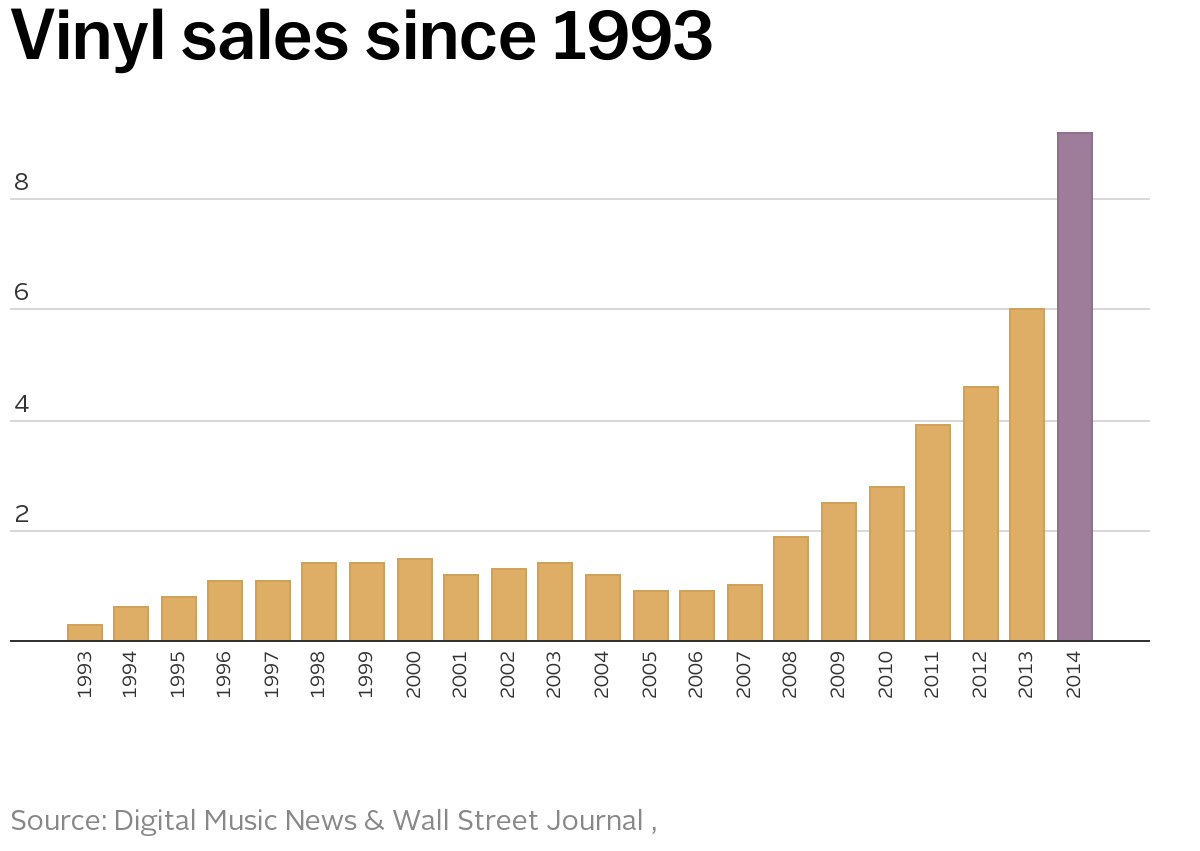
Well.. Yes... but that doesn't seem to stop sales. Last year record sales jumped up by almost 3 million more records sold than the previous year. Sales are now 13 times what they were in 2006. To be clear, 11.9 records were sold in 2015. Big chains are begin to sell records as well, not just local shops. (though I would argue those are still the best and least expensive) Urban Outfitters has begun to sell vinyl, Barnes and Noble, and even Best Buy. 

The records that are being sold are not just old records, but newly released albums are being transferred to vinyl format. The number one best selling album of 2015 was Adele's 25, following that was Taylor Swift's 1989. Others on the top ten are Arctic Monkeys, Alabama Shakes, and Hozier. So as you can tell, the albums being sold are from new artists.


What sets Vinyl apart?

http://7-themes.com/


Why is vinyl different?


We've all heard record oriented hippies confidently brag about the superiority of their sound, warmth and "realness". However how true are those claims?


The main other platforms for listening to music that are still used are CD and digital. In this post I'll explain the differences between vinyl and CD. The main difference between the two is the way that the music is recorded and later read. On vinyl there are actual grooves the a needle bounces along and interprets to produce the intended sound. On CD's a small laser is shot onto the disk, and whatever light bounces back tells the disk player what to do. 

However when one mixes the physical with digital one can run into issues. The grooves in a record limit some of what the music can do on a scale dynamic range. For example the needle cannot read music that makes a radical drop in tone because the actual needle will bounce off the surface of the record and skip parts of the song. Records can also warp, where the vinyl bends over time. They actual surface of the record can be worn down over time and change the sound.

In CD's none of this can happen, for the only thing touching the disk is light. They don't really warp, and can handle intense drops in tone. By all accounts CD's appear to be significantly better than vinyl in all aspects, accuracy of sound, resistance to change, and overall ease of use. 

The thing is, the needle on record sound isn't a negative. It creates a tiny bit of distortion on that transfers to the speakers, providing a sort of background ambiance for the music to play with. It's what many people describe as the "warmth" or "fullness" of records vs digital. Listening to records is also an experience, you pull the record out of you collection, shimmy it out of its sleeve, put it on the turn table, set the needle, then sit back and listen to the whole album without many other distractions. Its difficult and impractical to skip songs on records, forcing people to fully appreciate the story behind the album. The larger album cover also allows for better cover art. I could go on and on about the unseen advantages that arise from record's seeming inconvenience. It's those things that take a little extra time and care where the experience of listening to records comes from.


Don't even get me started...

http://createdigitalmusic.com/app/uploads/2011/07/loudness.jpg

The LOUDNESS War

(aka, what ruined the sound of modern music)

You may not be familiar with what the loudness war is, but you are definitely familiar with its effects. To explain, try to picture yourself in this situation. You are selling newspapers on the sidewalk of a busy street, you shout, "Extra! Extra!" People hear, and buy your paper. Now imagine a different newspaper hires a different newsboy to sell across the street from you. What are you going to do? Probably shout a little right? Shout louder, more people hear, more people buy. Now imagine that the number of paper boys increases tenfold... you're probably screaming at the top of your lungs. Well that's exactly what happened in the music industry.

For some reason people decided that louder is better. I have absolutely no idea why. However the fact remains that the new philosophy is that louder is better, so let's make all these tracks louder, purely in a sense of decibels. To do that one needs to decrease something called dynamic range. Dynamic range is the difference in sound between the softest and loudest note playing in a track. The thing that lets a song develop and move and sway and have... well... range

The three steps done in this process are as follows;
1) Decrease the dynamic range so no note is significantly louder or softer than any other
2) Increase the overall volume of the now modified track
3) Sound terrible

So say goodbye to crescendo, range, powerful vocals over soft instruments, focus on the specific instrument in a solo, and clear cut, non-scratchy music. So this, this is why digital music fails miserably in comparison to vinyl.


What sets Vinyl apart? (cont.)

https://sites.google.com/site/jsalsburey/macintoshsemiotics
This post is going to explain the differences between digital music files and vinyl records.

Digital music excels in one category, ease of use. No question about it. Music on your phone can be paused, rewound, shared, streamed, anything. In fact on your phone you have access to almost any piece of music ever recorded. It really is an amazing thing. However, everything comes at a cost, and with such a great gain, there is a great cost.

Quality. Simple as that. you cant compress music that once took up two full sides of a 12 inch disk into a microscopic space without losing some sound quality. That's obvious. The only question is how much do you lose? 

Quite a lot. Thanks to something called The Loudness War. It's not something that most people will complain about aside from certain audiophiles. And you lose it in two ways; dynamic range, and loudness. Dynamic range is the difference in volume between the softest note and the loudest. Loudness is, well, loudness.


Friday, March 18, 2016

The Resurgence of Vinyl

http://www.wileyroots.com

Overall Research Question
  •       Why is there a resurgence of vinyl decades after it became "obsolete"?
Sub-Questions
  • What is the difference between vinyl and other forms of music?
  • Why are people willing to pay more for vinyl when it is less convenient?
  • How has the death of vinyl affected the quality of modern music?
  • Will vinyl be back to stay? Or is it a passing phase?

Potential Research Websites
Economic Concepts
  • All choices have an opportunity cost.
  • People respond to incentives in predictable ways.
Emmett Ferguson